
Ceramics & history
You say Majolica, I say Maiolica… a brief outline of the origins of colourful earthenware ceramics
Whilst the potters of England were still in the Bronze Age, Assyrians were making decorative courses of brick covered with a glaze made white and opaque with tin oxide.
The glaze fell into disuse but the secret was rediscovered and the roots of today’s majolica developed in the medieval Islamic world. The expansion of Islam took tin glazing to Moorish Spain and then to Italy via the trading route of Majorca – or Maiorca in medieval Italian and hence the adopted name. The art of tin glazing soon spread to France where it is known as Faience, Germany where it’s known as Fayence, Holland (Delftware) and England where it began as Gallyware but we also call Delft. In Mexico, where it was introduced by Spanish settlers in the 15th century, it is known as Talavera (after the village in Spain where they mastered the technique). Learn more about tin glazed pottery.
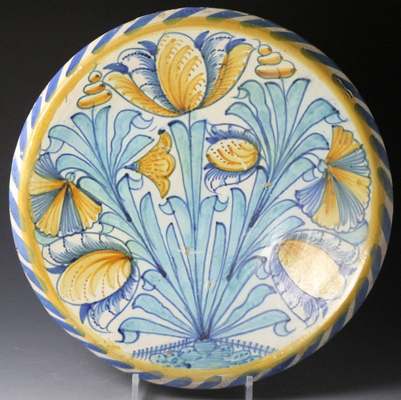
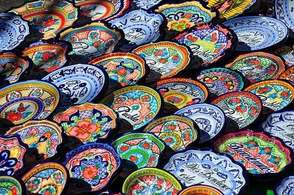
Up until this time, decorative techniques for pottery had been basic and predominantly brown. Decoration was added to pots using slip, incising, sgraffito and inlaying. The distinctive style of pottery known as majolica suddenly allowed for the possibility of bright colours to be applied, the most unusual being cobalt blue, mimicking the exotic ceramics of the Far East. Other colours were made from metal oxides and included;
- Green – copper
- Purple – manganese
- Yellow – antimony
- Orange/red – iron
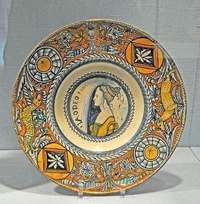
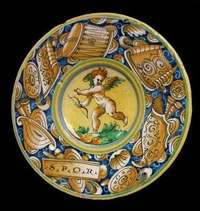
Maiolica was made extensively in Italy during the 15th and 16th centuries and maiolica dating from the Renaissance period is the most renowned. In certain areas, ceramics was a major contributor to the economy; Romagna, Faenza, which gave its name to faience, produced fine maiolica from the early fifteenth century as well as Orvieto and Deruta. The wares from this era are what we refer to as Maiolica with an I. The emphasis was on the decoration rather than the simplicity of an interesting glaze. This type of work was very time consuming and a difficult operation as tin glaze absorbs colour meaning that erasures were impossible – not a problem we have to worry about with the modern glazes we use in the studio. The tradition of fine maiolica died away in the 18th century, under competition from porcelains and white earthenware. But it remains commonly produced in folk art forms and reproductions of the historic style.
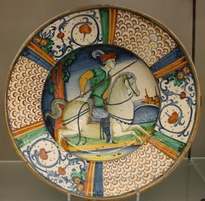
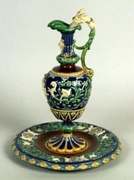
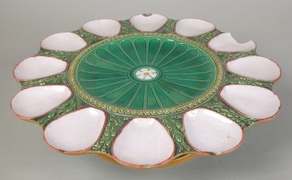
In 19th century England, renaissance ceramics were highly collectable and increasingly rare. Factories began making contemporary versions to meet demand and the simple ceramic shapes that majolica decoration traditionally adorned evolved into some of the most ornate relief moulded and brightly coloured lead glazed designs of the Victorian period. These wares are what we tend to refer to as Majolica with a J.
Come and make something real